
It’s “Kinda Chic” to Know When Not to Chase a Trend

But also - kinda chic to know how to play a social media trend and have fun with it.
If your Instagram feed has recently started telling you that it’s “kinda chic” to do things you have been doing your entire life without considering them chic, congratulations: you have discovered the latest social media microtrend.
Maybe it’s kinda chic to wear short, clean nails instead of a full set. Kinda chic to buy fewer, better things. Kinda chic to let your kids get dirty at the park. Kinda chic to carry an old tote bag instead of buying another one. Kinda chic to have hobbies that don't involve monetizing yourself. Kinda chic to know how to make a decent dinner. Kinda chic to use the big light. Honestly, at this point, breathing without a ring light is probably kinda chic.
The trend has been popping up across Instagram and other social platforms, with creators using the phrase to frame everyday choices, habits, purchases and lifestyle moments as effortlessly stylish or desirable. Real Simple jumped in on the conversation, publishing its own “Kind of Chic” roundup featuring everything from ballet flats and paper planners to short, clean nails and doing your own manicure at home.
And, naturally, the internet is already doing what the internet does best: enjoying the trend, overanalyzing the trend, making fun of the trend and then creating content about why everyone else is doing the trend wrong.
Which, frankly, is exactly why the social media team at Bennett Creative, think it’s worth talking about.

What is the “Kinda Chic” trend on social media?
The “Kinda Chic” trend is essentially a caption format that turns an ordinary thing into a lifestyle flex. The formula is simple: “Kinda chic to…” followed by something the creator has decided is understatedly cool, clever, tasteful or aspirational.
The joke is that the thing doesn't necessarily have to be traditionally luxurious or fashionable. In fact, the more mundane the thing, the better the format can work. Or even hot takes going against what feels like perfection culture or skinny culture (“kinda chic to be a woman who eats more than 1200-1500 calories a day).
It’s kinda chic to wear your grandmother’s raincoat instead of buying something new. Kinda chic to take your kids somewhere without turning the outing into a perfectly curated Instagram experience. Kinda chic to have a cheap pair of sunglasses you actually wear. Kinda chic to do your own nails. Kinda chic to have a hobby simply because you enjoy it.
The phrase works because it takes something that could otherwise be completely unremarkable and gives it a little editorial wink. Suddenly, your sensible decision not to spend $200 on a manicure isn't just financially responsible. It’s chic.
And that is a very social-media-native form of storytelling. The trend isn't really about the word “chic.” It's about reframing ordinary life as desirable.
Instead of showing people what you bought, you’re showing them how you live. Instead of saying, “Look at this thing I have,” you're saying, “Look at this choice I make.” Or using it as a clapback to culture.
Where did the “Kinda Chic” trend come from?
This is where things get a little fuzzier, which is increasingly common with social media trends. Unlike a dance with a clearly identifiable original creator or a sound that can be traced back to one TikTok, “kinda chic” seems to have evolved as a caption and content format across creators rather than having one obvious point of origin.
That actually tells us something important about how trends work now. A social media trend doesn't always need an inventor. Sometimes it needs a repeatable phrase.
Once enough people recognize the format, they can fill in the blank with their own version.
We’ve seen this happen more and more since the “It’s Very Important You…” trend. This formula makes the trend extremely easy to reproduce, which is basically jet fuel for an algorithm. You don't need to learn choreography. You don't need special editing skills. You don't even need to come up with a particularly original idea. You just need a photo, a thought and the confidence to declare it chic.
The format has spread far enough that publications are now adopting it, too. Real Simple's recent “Kind of Chic” feature uses the language to curate products and everyday habits that supposedly add a little effortless polish to life.
And once a trend moves from creators into editorial content and brand marketing, you know we've entered a very specific stage of the social media life cycle: the moment when the people who started the trend are already tired of it and the marketing department has just discovered it.
Which brings us to the backlash.
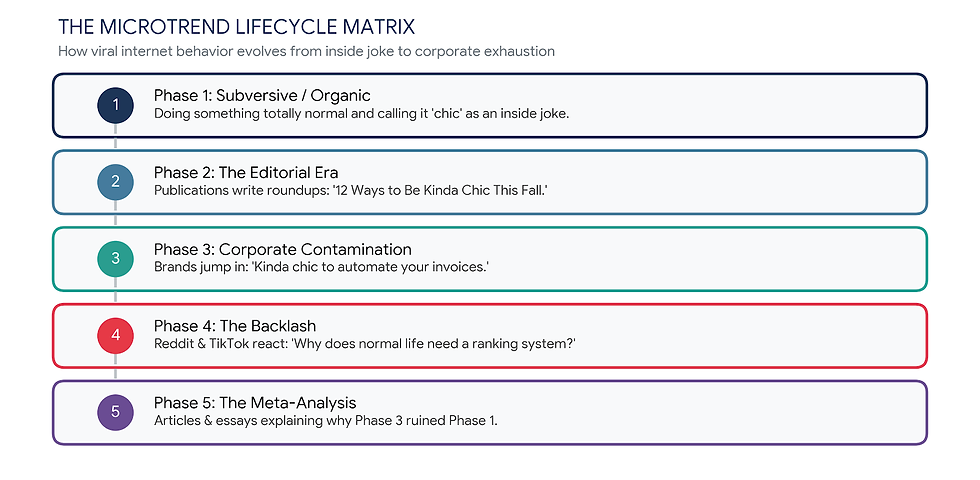
Why are people annoyed by the “Kinda Chic” trend?
As it turns out, not everyone wants their existence categorized like a Pinterest board.
There is already a growing backlash against the trend, with social media users calling it annoying, repetitive, pretentious and overly self-congratulatory. One Reddit discussion about the trend accumulated more than 100 votes, with commenters arguing that “chic” is being used to describe virtually anything and that the format can create an implied sense of superiority. Another discussion described the trend as a new version of the “quiet luxury” or “old money” aesthetic.
And honestly? The criticism isn't completely unfounded. There is a subtle difference between saying, “I really love wearing my grandmother's old coat,” and saying, “Kinda chic to wear your grandmother's old coat.” The first is a personal preference. The second turns that preference into a tiny lifestyle philosophy.
That is where some people start to feel the ick.
The trend can sometimes imply that one way of living is more tasteful, intelligent or sophisticated than another. Kinda chic to buy less. Kinda chic to skip the flashy manicure. Kinda chic to travel light. Kinda chic to shop vintage.
Fine. But eventually the internet starts asking: Who decided that?
And perhaps more importantly: Why does everything we do now need a ranking system?
Social media has become remarkably good at turning completely normal human behavior into an aesthetic hierarchy. We don't just drink coffee anymore. We romanticize our morning coffee. We don't just wear clothes. We have aesthetics. We don't simply take pictures. We have a facial expression that apparently represents an entire generation.
The “Kinda Chic” backlash is partly a reaction to that phenomenon.
Why does social media keep turning tiny behaviors into trends?
This may actually be the most interesting part of the entire “Kinda Chic” conversation.
The New York Times examined the phenomenon through the “Gen Z pout,” a facial expression that became the subject of surprisingly intense internet analysis. The article pointed out that the slightest movements or behaviors of young people are increasingly being identified, labeled and turned into generational microtrends. There was the Gen Z pout, before that the Gen Z stare, along with endless debates about side parts, skinny jeans, socks and other tiny details of personal style.
In other words, we have reached a point where the internet can turn a facial muscle movement into a cultural event.
There is a reason these labels work: They are incredibly shareable. “People are wearing their hair differently” isn't particularly interesting. “The Death of the Side Part” is a headline. “Some young people are pursing their lips in photos” isn't exactly a cultural analysis. “The Gen Z Pout” is.
The label gives people something to debate.
Are you a Gen Z pout person? Is the Gen Z stare real? Are skinny jeans back? Is this chic? Is that demure? Is your morning routine coastal grandmother, clean girl, quiet luxury or something called “tomato girl” that will be completely embarrassing in six months?
Social platforms reward this kind of categorization because it creates conversation. The New York Times noted that labels such as “Gen Z pout” can be particularly effective on algorithmic platforms because they invite people to argue about whether the label is even accurate in the first place.
That is an important lesson for marketers. The label doesn't necessarily have to be true to be powerful. It just has to be interesting enough to make people want to discuss it.
“Kinda chic” works the same way.
People aren't necessarily searching for a definitive definition of chic. They are reacting to the idea that something they already do, or something they absolutely refuse to do, has suddenly been declared chic.
And once you give people something to agree with, disagree with or make fun of, you've given them a reason to engage.

Is “Kinda Chic” the new quiet luxury?
Kind of. And this is where the trend gets particularly interesting.
Quiet luxury has been one of the defining aesthetic ideas of the past few years: understated clothing, neutral colors, quality materials, minimal logos and the general suggestion that you are wealthy enough not to need everyone to know you're wealthy. Now, we're seeing a similar idea filter into much more ordinary lifestyle content.
Instead of “I wear expensive cashmere,” it's “I wear the same sweater I've owned for eight years.” The quiet luxury girlies opt for clean short nails instead of a dramatic nail set. Tote bags are chosen over an obviously expensive bag covered in logos. Instead of constantly chasing the newest thing, it's knowing when not to buy something at all.
The shift is subtle but meaningful. The aspiration is moving away from obvious consumption and toward perceived discernment. And that is exactly why the backlash can be so funny. Once “not trying too hard” becomes an aesthetic, everyone starts trying very hard to look like they aren't trying. That contradiction is practically the entire internet in one sentence.
What 'Kinda Chic' is really selling isn't understated style, it's performative indifference. It’s the art of proving you care so little about status symbols that your lack of caring becomes the ultimate status symbol. It’s anti-flex flex culture.
Even Reddit commentary around “Kinda Chic” has explicitly connected the trend to quiet luxury and old-money aesthetics, with critics arguing that it can amount to trying to manufacture an effortless, wealthy-looking lifestyle through carefully selected purchases.
Meanwhile, beauty trends are following a similar trajectory. The appeal of simpler nails, pared-back beauty and less obviously elaborate styling fits neatly into the broader idea that effortlessness itself has become aspirational. Which is hilarious when you think about how much effort goes into making something look effortless.
How can brands use the “Kinda Chic” trend without looking cringe?
Here's where we would tell brands to take a deep breath: You probably don't need to jump on this trend.
We know. A social media agency just said don't jump on a social media trend. Call the newspapers. But there's a difference between participating in a trend and understanding why a trend is working.
The worst brand content happens when a company sees a phrase trending and immediately asks, “How can we make this about our product?” That is how you get a mattress company posting “Kinda chic to sleep eight hours a night” approximately 14 minutes after everyone else is already sick of the phrase.
The problem isn't necessarily that the brand participated. The problem is that the audience can see the machinery behind the post. It feels like someone in a conference room said, “Guys, I have an idea. What if we use the TikTok thing?” And nothing says “cool” quite like the unmistakable scent of a marketing meeting.
Instead, brands should ask a different question: What is the audience finding funny or interesting about this trend?
If the answer is the tension between being understated and wanting everyone to notice how understated you are, there may be an opportunity for a clever comment. If a brand has a genuinely funny take on the trend, make the joke. If your brand naturally fits the conversation, participate. If your audience is already talking about it, join the conversation without trying to make yourself the main character.
Sometimes the best brand move is simply leaving a smart comment on someone else's post. Or make a post about why you aren't participating in the trend. Or better yet, taking the underlying idea and creating something original around it.
For example, a home brand doesn't necessarily need to post “Kinda chic to use our linen sheets.” But it could make a genuinely funny observation about how the internet has somehow decided that owning fewer things is chic while simultaneously selling you 14 new things you apparently need to achieve the look. Now you've got a point of view. And point of view is much harder to fake than trend participation.
What can marketers learn from the “Kinda Chic” trend?
The biggest lesson isn't “use the words kinda chic.” Please, for the love of the algorithm, do not put “kinda chic” on every Instagram graphic next week. Then it becomes the equivalent of having someone push the “seems like AI slop” button on LinkedIn.
The lesson is that people want content that gives everyday experiences a point of view.
The most effective trends often provide a shortcut to storytelling. They give people a format they can immediately understand and personalize. “Kinda chic to…” is essentially a fill-in-the-blank storytelling device, just like the “preparing for my netflix documentary…” trend.
That is useful information for brands. Instead of constantly asking, “What trend should we use?” ask, “What storytelling format could make our audience see something familiar differently?”
Maybe your product isn't revolutionary. But the way your customer uses it might be interesting. Or maybe your service isn't inherently funny. But there is something ridiculous about the problem it solves. Maybe your brand doesn't belong in the trend. But your perspective on the trend does.
That's where social media gets good, because the goal isn't to prove that your brand knows what is trending. The goal is to prove that your brand understands the people who are consuming the trend.
There is a big difference.

So, should your brand participate in the “Kinda Chic” trend?
Before you type “Kinda chic to…” into Canva, ask yourself whether what you’re posting is actually funny or relevant, whether your audience would care and whether your brand has earned the right to be part of the conversation.
If all three answers are yes, go for it.
If the answer is “our social media manager saw it on Instagram and thinks it might be good for engagement,” perhaps step away from the Canva template.
Trends move fast. By the time a brand approves a trend-inspired post, gets legal to review it, schedules it in the content calendar and publishes it at 9:00 a.m. Tuesday, the internet has already decided that the trend is embarrassing and moved on to something called “quiet maximalism,” which is presumably just buying 47 colorful throw pillows.
The smarter strategy is to watch the trend, understand the cultural conversation around it and decide whether your brand has something genuinely interesting to add.
Sometimes that means participating. Sometimes it means commenting. Sometimes it means taking the underlying idea and turning it into something that feels unmistakably yours. And sometimes the most sophisticated social media strategy of all is knowing when not to post.
Let’s be honest, it’s kinda chic to have a social media agency like Bennett Creative helping you figure out the trends. Reach out if you need some help!


I prefer digital systems that keep different services under one account. The SSO Login facility provides a common access point, making it easier for users to manage government applications and other online requirements without switching between multiple accounts.
I was looking for information about checking an application and found this article useful. The explanation of Suhbadra Yojana Status is easy to follow, with clear guidance that can help users understand the relevant online checking process.
This analysis of the "Kinda Chic" trend highlights how social media constantly reframes ordinary life as aspirational, sometimes leading to an aesthetic hierarchy. The discussion on the backlash, questioning "Who decided that?", really captures the current fatigue with labeling every mundane choice. https://cellesim.com/ for more on navigating authenticity in a trend-driven world.
If you’re into word games, give Wordle a try. It’s quick, simple, and great for practicing your guessing skills.