
The Kumar Method: Why a Retired Accountant Is Going Viral on Social Media

Updated: Jun 23
A retired accountant in rimless glasses telling finance bros he’s coming for their jobs was not on our 2026 bingo card. Yet here we are.
If you’ve spent any time on Instagram or TikTok recently, you’ve probably run into The Kumar Method. Maybe it was a dry one-liner delivered with confidence in a black turtleneck. Or maybe it was a comment section exchange that felt less like a business account and more like a Gen Z social media manager having the time of their life.
Whatever video introduced you to Kumar, chances are you did what we did. You watched another one. Then another. Then another.
At Bennett Creative, we recently sat down to see what all the hype was about. We obviously had to watch all six videos in completion. No scrolling. No multitasking. No checking emails. Just fully invested in the ongoing saga of Kumar, his wife, and whatever unexpected storyline was about to unfold next. We were laughing and quoting lines. We were sending videos to each other.
And that's exactly why marketers should pay attention.
Because while The Kumar Method might look like just another viral trend, it's actually a masterclass in modern storytelling.
What Is The Kumar Method?
The most common question people are asking is simple: what is The Kumar Method?
On the surface, it’s a social media content series built around Kumar, a retired accountant turned internet personality who delivers business commentary, motivational ideas, and dry humor through cinematic, highly stylized videos.
But that description misses the real reason it works.
The product isn’t accounting insight. The product is character-driven entertainment. Everything is built around contrast — an older man with a distinct accent delivering bold, almost confrontational messaging to “finance bro” culture and modern internet behavior.
That contrast creates instant curiosity, but more importantly, it creates emotional buy-in.
Kumar doesn’t look like your typical social media influencer but he delivers the hooks and script like a pro. He looks like the underdog - he’s not 6 '5 with blue eyes (looking for a man in finance), he’s a gray-haired boomer with rimless glasses.
And you want to root for him - largely because his wife asked nicely and he’s aura farming like a Gen Z.
Why Is The Kumar Method Trending?
To understand why The Kumar Method is trending, you have to look at how social media attention actually behaves in 2026.
Audiences don’t reward content for existing anymore. They reward it for holding them.
Andrew, Bennett Creative’s CEO, hot take on this is simple but important: the success of Kumar comes from a classic underdog narrative structure. The same emotional pattern you see in stories like Grogu, Rocky, Luke Skywalker, or Katniss Everdeen.
It’s not about age or profession or even the content itself. It’s about watching someone unexpected step into a space where they are not supposed to dominate. Then watching the audience decide they want that person to win. Grogu can’t die because he needs to grow up to be Yoda. Katniss must defeat Snow and save the lower districts.
That emotional alignment happens almost instantly. And once it does, retention follows.
Because people don’t just watch the content. They invest in the outcome and love a good storyline. We want to be hooked. To have our curiosity piqued. Kumar has got us in his clutches.
Why Did The Kumar Method Go Viral?
When people ask why did The Kumar Method go viral, the answer isn’t a single tactic or editing trick (although the editing is a huge part of it). It’s the layering of several behavioral triggers that reinforce each other.
Andrew also points out the importance of pattern interruption. The videos don’t look like what viewers expect from the persona being presented. Instead, they use fast-paced, almost Kendrick Lamar-inspired editing, punchy transitions, and high-energy pacing that contrasts sharply with Kumar’s calm, understated delivery.
That mismatch is intentional. It creates friction and friction creates attention.
You’re not just watching a man speak. You’re trying to reconcile why the visuals feel so modern while the character feels so grounded and unexpected. That cognitive tension is part of what keeps people watching.
Who Is Kumar (and Why Does It Matter Less Than You Think)?
Another common search is “who is Kumar”, but that question reveals something interesting about how the internet consumes characters now.
We’re used to origin stories. We want context, credentials, background, justification.
Kumar skips most of that. We don’t know who he is other than a retired accountant with an amazing wife. But we’re going to stick around and find out.
He enters social media as a fully formed presence. Not as someone being introduced, but as someone already in motion. And that’s the point. The audience isn’t being asked to evaluate his credibility. We’re being asked to follow his narrative.
That shift from “information-first” to “character-first” is one of the biggest reasons the content works at all.
Why Kumar’s Wife Is Keeping Us Hooked
One of the most unexpectedly effective elements of the entire series is Kumar’s wife.
Viewers consistently respond to her presence not just as supporting context, but as an essential part of the entertainment structure itself. The editing shifts from cinematic to iphone footage that’s raw and something you’d more expect from a set of Boomers. But it feels welcome, like a record scratch.
She adds reaction, humor, skepticism, and grounding energy to a character who could otherwise drift into monologue territory.
Without her, the content is borderline villain. With her, it becomes a relationship. And that relationship is what turns individual videos into something closer to an ongoing series.
Audiences aren’t just watching Kumar speak. They’re watching dynamics unfold.

The StackSmiths Kumar Website Controversy and the Virality Industrial Complex
As The Kumar Method gained traction, something else started happening in parallel — the internet began building infrastructure around it.

One of the most visible examples is a website tied to StackSmiths. They built an unofficial spec page where it’s full-on marketing for StackSmiths. They built the website in a weekend and are willing to hand the website over to Kumar - free of charge - whenever he wants it.
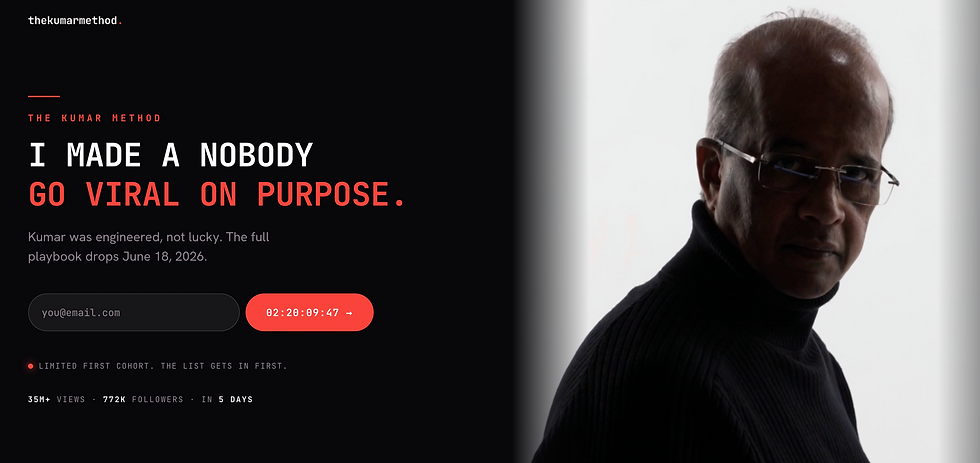
Another website has popped up which claims to outline a “playbook” behind Kumar’s viral success. The framing suggests a structured system, almost as if the entire phenomenon was engineered or packaged by an agency.
This is where things get dodgy. Both of these websites are not officially associated with Kumar, and Kumar himself has publicly clarified that he does not own or operate an official website. Despite that, the site continues circulating as if it represents an inside explanation of the strategy.
Going viral can get very interesting — and slightly chaotic. The moment something starts gaining attention, multiple layers of interpretation, monetization, and narrative-building appear on top of it. Agencies, creators, and third parties begin attaching themselves to the trend, either to explain it, replicate it, or benefit from association.
In this case, the StackSmiths site raises a bigger question than whether it’s accurate. It asks whether virality now immediately triggers a secondary economy of explanation.
And in many ways, it does. The internet doesn’t just observe trends anymore. It builds frameworks around them in real time — sometimes before the original story is even fully understood.
Why Are Cinematic Videos Performing Well on Social Media?
For years, creators were told to ditch polish in favor of raw, handheld authenticity.
And while that shift did change what people saw on social media, it didn’t eliminate demand for quality. What we’re seeing now is a correction.
Andrew Bennett’s observation here is simple: audiences don’t reject production value. They reject content that feels disconnected from intention.
The Kumar Method works because it uses cinematic tools — framing, pacing, color, editing rhythm — without losing narrative clarity. The production doesn’t overpower the story. It supports it.
That distinction is why cinematic videos are performing well again on social media.
They feel intentional, not artificial.
Does High-Quality Video Perform Better on Social Media?
This naturally leads to the question businesses constantly ask: does high-quality video perform better on social media?
The answer is yes, but only under one condition — it has to serve the story. Story is everything.
High production value alone doesn’t guarantee attention. In fact, when used without narrative purpose, it can create distance between the audience and the content. The Kumar Method avoids that entirely.
The visuals feel elevated, but not sterile. The editing feels sharp, but not over-produced. Everything exists in service of character and story progression. That’s the real takeaway for brands: Quality matters. But only when it feels like it belongs.
What Makes Content Go Viral in 2026?
If you strip away tactics and trends, what makes content go viral in 2026 is still surprisingly consistent.
Andrew’s breakdown points to four recurring patterns: strong character identity, emotional alignment, structural repetition, and entertainment value that outweighs informational intent.
Kumar hits all four. He isn’t just delivering messages. He’s building familiarity. And familiarity is what turns viewers into return viewers. He’s also driving curiosity. We’re staying tuned because we want to see how this plays out. Plus the comment sections are fire.
Can Brands Replicate The Kumar Method?
This is where most businesses misunderstand virality.
Can brands replicate The Kumar Method? Yes, and it's blowing up.
Brands can absolutely replicate the underlying principles — recurring identity, narrative continuity, emotional positioning, and content that prioritizes engagement over explanation.
Rapidio quickly created their own video featuring Ashwath in a replica of the Kumar Method videos. It wasn’t quite as aura farming, but it wasn’t a total miss...

What Can Businesses Learn From The Kumar Method?
At its core, The Kumar Method reinforces a shift that’s already well underway: attention is no longer earned through clarity alone. It’s earned through connection.
People don’t follow content because it explains something well. They follow it because it makes them feel something — curiosity, humor, recognition, or even confusion that turns into investment.
And in a feed where everything is competing for the same few seconds of attention, that emotional pull is the only real advantage left.
What Social Media Trends Should Businesses Pay Attention To?
The biggest trend worth paying attention to right now isn’t aesthetic. It’s structural.
Audiences are increasingly rewarding content that behaves less like individual posts and more like an unfolding world. That means recurring characters instead of one-off campaigns, story arcs instead of isolated announcements, and dynamics instead of static descriptions.
The Kumar Method may eventually fade the way all viral moments do. That’s normal. That’s the internet. But the pattern underneath it isn’t going anywhere.
Whether it’s Kumar or the next unexpected character that takes over a feed, the underlying truth stays the same: people don’t just want content anymore. They want something they can follow. Something that might have some drama unfold with it.
For brands, that’s where the opportunity really sits — not in chasing whatever is trending, but in building narratives people actually return to. It’s the same shift we spend most of our time at Bennett Creative helping clients adapt to: moving from content as output to content as story, so attention isn’t just captured once, but earned again and again. Reach out if this is something you're looking for in your brand's social media marketing.
But the Bennett Creative team will be following along with The Kumar Method because we’re hooked and dying to see how this plays out.


Me pareció interesante esta información sobre Magis TV porque explica el tema de forma sencilla. Para quienes desean conocer la plataforma antes de utilizarla, puede servir como una referencia inicial. También conviene revisar los requisitos, la compatibilidad y las condiciones de uso antes de instalar cualquier aplicación
Gather a group of four for Uno Online's 4-player mode, and you can be sure the room will be filled with laughter (and swearing) over Discord.
Playing Among Us Online reminded me that good observation can be more useful than rushing, particularly when trying to identify an Impostor from subtle behavior.
Seasonal events in subway surfers unblocked always bring new skins, new characters, and exciting rewards for players.